
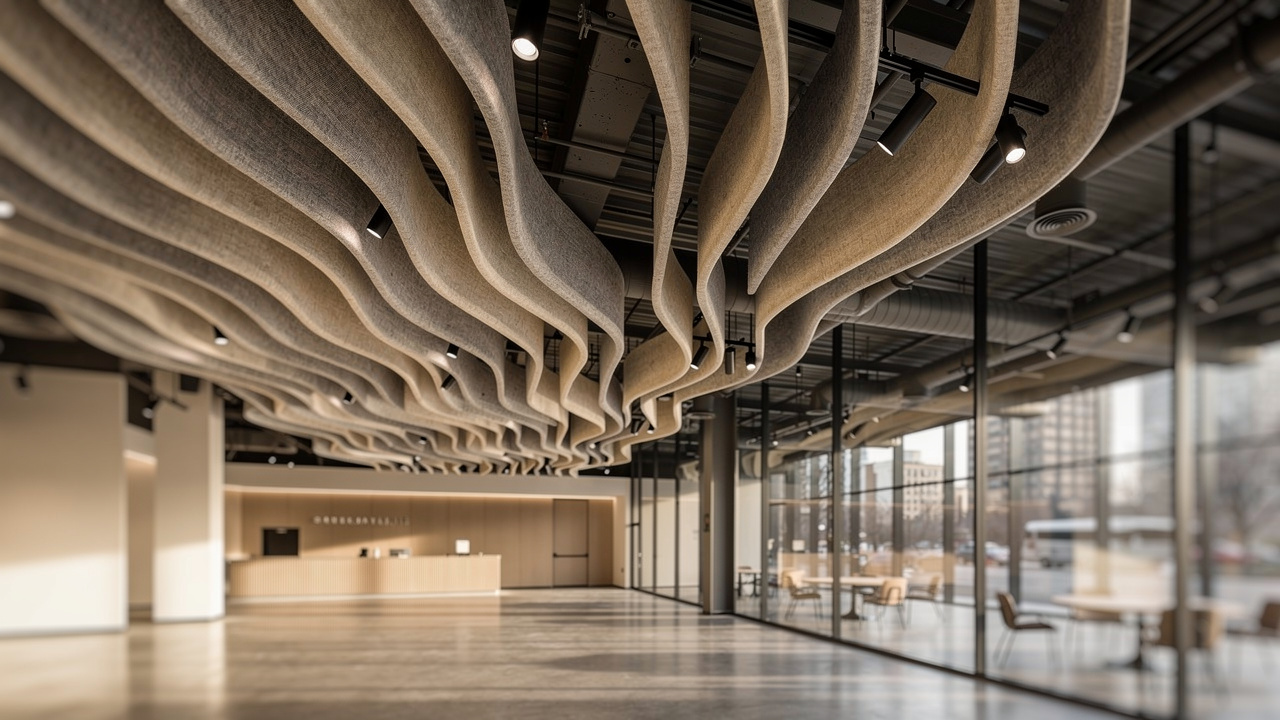
Open floor plans, glass walls, and polished concrete floors define much of Algeria’s new hotel, office, and retail construction. These hard surfaces look sharp, but they bounce sound instead of soaking it up, leaving lobbies, classrooms, and meeting rooms plagued by echo and muddled speech. Architects and procurement teams need a fix that solves the noise problem without covering up ductwork, sprinklers, or ceiling height.
The root cause is simple physics. Reflective materials send sound waves bouncing around a room rather than absorbing them, and this raises background noise and hurts speech clarity in busy commercial spaces.
Acoustic PET ceiling baffles for Algeria give architects and contractors a way to cut reverberation while keeping ceilings open and services visible. Made from recycled polyester fiber, these suspended panels absorb sound, meet fire safety codes, and come in dozens of shapes and colors. This guide from DeSound covers how PET baffles perform, comply with fire and environmental standards, and fit into large-scale Algerian projects.
Read on to see how the specifications stack up for your next project.
Key Takeaways
PET ceiling baffles absorb sound at NRC ratings between 0.75 and 0.95 while keeping the structural ceiling and services fully visible.
The panels are made from recycled polyester fiber, which supports green building points under LEED, BREEAM, and Edge schemes.
Class A or Euroclass fire ratings are a non-negotiable requirement for Algerian commercial and hospitality compliance.
Extensive color, shape, and printing options let architects turn an acoustic fix into a design feature.
DeSound supplies ready-stock baffles with CNC customization and technical support for bulk Algerian projects.
What Are Acoustic PET Ceiling Baffles?

Acoustic PET ceiling baffles are suspended, three-dimensional panels made from recycled polyester fiber that hang from a ceiling grid or structural soffit to absorb airborne sound. Manufacturers shred plastic bottles into fiber, then layer and heat-press the strands into a rigid board without formaldehyde-based resins or chemical binders, a process independently confirmed by updated life cycle data on recycled polyester showing reduced environmental impact versus virgin fiber production. Because each baffle hangs freely, sound waves strike it from multiple sides, making the material more efficient per square meter than a flat panel mounted flush to a wall.
Traditional mineral wool and fiberglass panels rely on woven glass fibers and resin binders that can irritate skin during installation. PET felt skips both problems, staying lightweight, non-friable, and safe to handle on site, which simplifies logistics for contractors managing large Algerian fit-outs.
Why Do Algerian Commercial Projects Need Acoustic Ceiling Baffles?

Algeria’s commercial boom is filling hotel lobbies, corporate offices, malls, and campuses with hard, reflective finishes such as glass, polished concrete, and stone. These surfaces reflect rather than absorb sound, so reverberation builds up quickly in open-plan offices, restaurants, and classrooms, making speech hard to follow and background noise tiring for occupants. Acoustic ceiling baffles for Algeria address exactly this gap, giving designers a targeted way to pull excess sound out of a room.
Because baffles hang individually rather than forming a solid ceiling, they let architects keep exposed ductwork, sprinklers, and structural height as part of the design instead of hiding it behind a suspended grid. This matters most in retrofit projects, where adding a full ceiling means costly structural work and lost headroom. Baffles solve the acoustic problem while preserving the open look that many Algerian hospitality and office briefs call for.
What Acoustic Performance Should You Look For?

Acoustic performance is measured using the Noise Reduction Coefficient, or NRC, a scale from 0 to 1.0 showing how much sound a panel absorbs rather than reflects. Quality PET baffles typically score between 0.75 and 0.95, depending on thickness, density, and spacing between panels. That range covers the 500Hz to 4000Hz band, which is exactly where human speech sits, making baffles effective in restaurants, classrooms, and open offices.
A few factors determine how well a given baffle performs:
Panel thickness usually runs from 9mm to 24mm, and thicker boards generally absorb more low-frequency noise such as HVAC hum or traffic rumble, a relationship also explored in acoustic performance optimization research on fiber-based composite panel designs.
Spacing and mounting height matter too, since denser spacing and a wider air gap behind each baffle both raise the total sound absorbed in a room.
Third-party test reports such as ISO 354 or ASTM C423 should be requested from suppliers instead of relying on marketing claims alone, since case studies on measurement and prediction of airborne sound insulation performance show how lab conditions and mounting configuration can shift real-world absorption results.
These lab results confirm the NRC figure applies to the exact product and configuration going into the building, not just a generic sample.
| Panel Thickness | Typical NRC Range | Best Suited For |
|---|---|---|
| 9mm to 12mm | 0.75 to 0.85 | Mid and high-frequency speech clarity |
| 15mm to 20mm | 0.85 to 0.90 | Open offices, classrooms, conference rooms |
| 24mm and above | 0.90 to 0.95 | Low-frequency noise, HVAC hum, large volumes |
Fire Safety and Compliance Requirements
Fire performance is not optional for any material installed overhead in a public building, and Algerian project approvals increasingly reference the same European fire codes used across the Mediterranean and Gulf markets. Reputable PET baffle products carry a Euroclass B-s1, d0 or B-s2, d0 rating under EN 13501-1, confirming limited combustibility, low smoke output, and no flaming droplets during a fire event. Some product lines also carry an ASTM E84 Class A rating, useful for projects following American specification standards.
Procurement managers should request laboratory-issued fire certificates, not marketing brochures, before confirming any bulk order. Distributors supplying the Algerian market should keep this documentation current, since customs clearance and project sign-off both depend on verifiable, up-to-date test paperwork.
Tip: Always ask for the fire certificate to be matched to the exact product batch and thickness you are ordering, not a generic reference sample from the same product family.
How Do PET Baffles Support Design Flexibility and Sustainability?

PET baffles support design flexibility because color is mixed into the fiber during production rather than sprayed on afterward, so designers can specify bold retail colors, neutral corporate tones, or gradient effects without worrying about fading. Shapes range from flat rectangular blades to curved, angled, or circular profiles, letting architects build sculptural ceiling features in hotel lobbies and atriums. Because each baffle hangs independently, the system integrates cleanly with pendant lighting, HVAC diffusers, and sprinkler heads instead of forcing a redesign around them.
On the sustainability side, PET baffles are typically made from 60% to 100% recycled polyester fiber, diverting plastic bottle waste from landfill into a long-life building product, a shift documented in reporting on recycled polyester bottle-to-fiber conversion at industrial scale. The material can often be recycled again at the end of its service life, and its recycled content can contribute credits toward LEED, BREEAM, and Edge certification, an increasingly common requirement for international hotel brands building in Algeria.
How Should You Source and Install PET Baffles for Large-Scale Projects?

Large installations typically use one of three suspension methods:
Steel cable suspension for precise height control
Aluminum track systems for faster coverage across big areas
Direct-fixing brackets for lower-height feature walls
Contractors should coordinate suspension points with MEP teams early, since ductwork, sprinkler heads, and lighting runs often occupy the same ceiling zone as baffle cabling, and clashes found mid-installation cost time and money, as illustrated in technical product sheets for modular ceiling baffle systems that detail standard suspension clearances.
On the procurement side, bulk buyers should confirm lead times for custom colors or shapes, since these take longer to produce and ship than stock rectangular baffles. It also pays to verify batch-to-batch color consistency, dimensional tolerances, and warranty terms covering structural integrity and acoustic performance, particularly on large Algerian projects where hundreds of panels must line up visually across one ceiling plane.
Why Choose DeSound for Your Algerian Acoustic Baffle Project?
DeSound supplies acoustic PET ceiling baffles built for the pace and scale of Algerian commercial and hospitality fit-outs. Ready-stock inventory keeps fast-track projects on schedule, while precision CNC cutting and custom UV printing let architects specify exact shapes, sizes, and branded finishes rather than settling for standard blades. With more than 100 color options available, design teams can match baffles to a corporate palette or a hospitality brand guideline without compromise.
Every panel is Class A fire-rated and tested for high acoustic performance, so procurement teams get compliance-ready documentation alongside strong sound absorption. The technical support team also helps calculate coverage, spacing, and configuration before installation begins, reducing guesswork for contractors handling their first large-scale baffle project in the region.
The Takeaway
Acoustic PET ceiling baffles give Algerian architects, contractors, and procurement teams a way to solve reverberation problems without sacrificing open ceilings, exposed services, or design ambition. The right specification balances NRC performance, verified fire ratings, and recycled content documentation against the practical realities of lead times, batch consistency, and installation logistics on a busy commercial site.
Before finalizing any order, request third-party test reports, fire certificates, and physical samples so the design team can confirm color and texture in person. Working with a supplier such as DeSound, which combines ready-stock supply with CNC customization and technical guidance, helps keep large-scale Algerian projects on schedule without compromising acoustic performance or compliance.
Frequently Asked Questions
How Thick Should Acoustic PET Ceiling Baffles Be For Commercial Spaces?
Most commercial projects use panels between 9mm and 24mm thick, with thicker boards absorbing more low-frequency noise like HVAC hum. The right thickness depends on room volume and the type of noise source, so acoustic modeling is worth doing before finalizing the specification.
Can PET Ceiling Baffles Be Installed Without A Full Suspended Ceiling?
Yes, baffles hang independently using cable, track, or direct-fix brackets, so no full suspended ceiling is required. This makes them a strong fit for spaces with exposed ductwork or retrofit projects where adding a complete ceiling isn’t practical.
Are PET Acoustic Baffles Safe For Indoor Air Quality?
Yes, quality PET baffles contain no formaldehyde, VOCs, or respirable glass fibers, since they are thermally bonded rather than chemically treated. This makes them suitable for healthcare, education, and hospitality projects with strict indoor air quality standards.
How Long Do PET Ceiling Baffles Last In Humid Or High-Traffic Environments?
PET baffles resist moisture, sagging, and mold under normal humidity conditions, and many product lines feature wipeable or washable surfaces. This makes them a durable choice for busy hospitality and food service spaces that need frequent cleaning.
What Is The Typical Lead Time For Custom-Colored Or Custom-Shaped Baffles?
Stock rectangular baffles in common colors ship faster than custom shapes, printed graphics, or custom color matches, which need extra production time. Project teams should factor longer lead times into schedules for fast-track hotel or retail openings.
Do PET Ceiling Baffles Help With Green Building Certification In Algeria?
Yes, their recycled PET content and available environmental product declarations can contribute credits toward LEED, BREEAM, and Edge certification schemes. Procurement teams should request documented recycled content percentages from suppliers to support certification paperwork.