
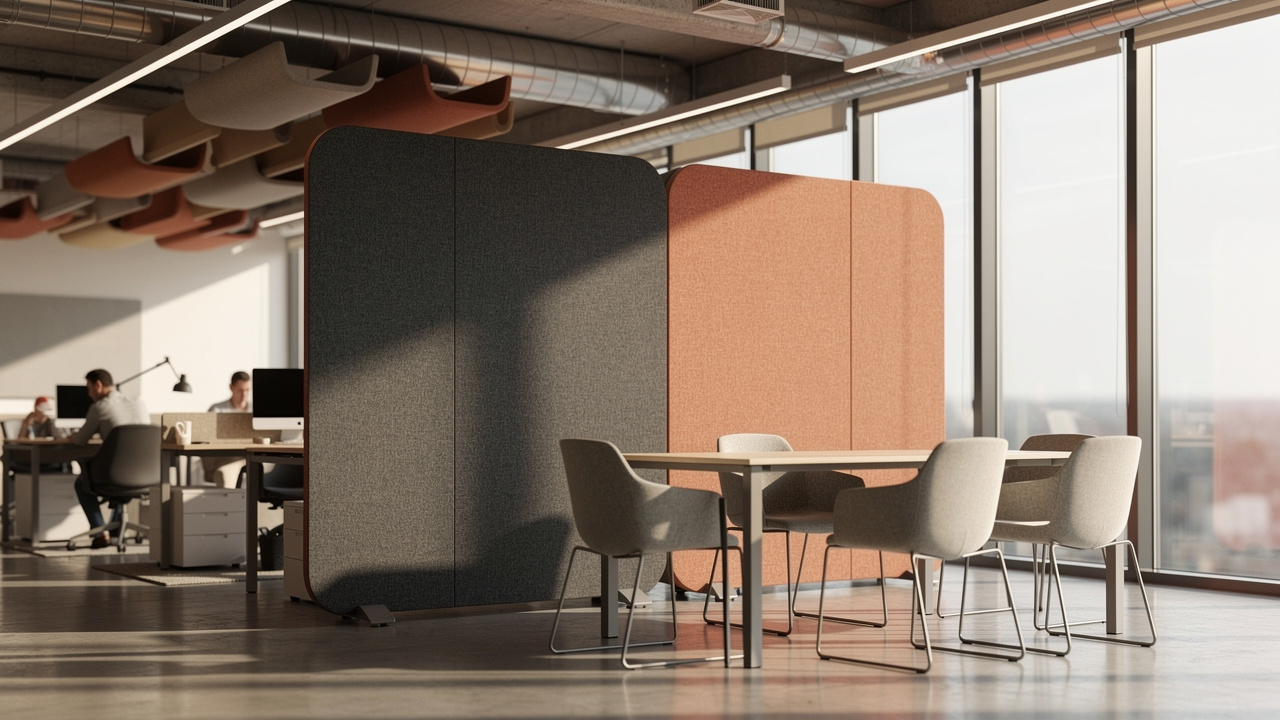
Corporate offices across Tunis, Sfax, and Sousse are dealing with a common headache: open floor plans that turn every phone call and hallway chat into background static. Glass partitions, polished concrete, and bare ceilings look sharp on a mood board, but they bounce sound around instead of soaking it up. That constant echo wears on staff, slows meetings down, and makes private conversations hard to keep private.
This is exactly where modern acoustic solutions for Tunisia come into play. Polyester, or PET, acoustic panels have become the standard answer for offices that want quiet without giving up a clean, modern look. DeSound, a Tunisian supplier of PET acoustic panels, works with architects, contractors, and procurement teams to bring fire-rated, high-performance panels into commercial fit-outs at scale.
This guide walks through why offices need acoustic treatment, how PET panels perform, what to check before buying in bulk, and how a supplier like DeSound fits into the process. Read on to see what separates a panel that just looks good from one that actually works.
Key Takeaways
PET acoustic panels are now the standard modern acoustic solution for Tunisia’s corporate offices, replacing older foam and fiberglass products.
Specification approval depends on hard numbers such as NRC ratings and fire classification, not marketing claims alone.
Custom shapes, colors, and printed branding let offices blend acoustic control with corporate identity.
Bulk fit-out projects need steady batch quality and short lead times, not just a good price.
DeSound supplies ready-stock, Class A fire-rated, high-NRC panels built for mid-to-large office projects in Tunisia.
Why Do Corporate Offices in Tunisia Need Acoustic Treatment?

Corporate offices in Tunisia need acoustic treatment because open floor plans, glass walls, and hard flooring send sound bouncing around a room instead of absorbing it. Modern office design favors these hard, reflective finishes for their clean look, but they turn ordinary conversation into a steady hum of background noise. Reverberation builds up quickly in large, open areas, making it harder for colleagues seated even a short distance apart to hear each other clearly. Without soft, sound-absorbing material somewhere in the room, that noise has nowhere to go.
This noise buildup carries a real business cost. Employees lose focus during calls and quiet work, which slows output over a full workday. Meeting rooms without acoustic treatment leak conversation into open areas, undermining confidentiality during sensitive discussions. Over time, staff in noisy offices report lower satisfaction with their workplace, which can affect retention in a competitive Tunisian labor market.
What Are PET Acoustic Panels and How Do They Work?

PET acoustic panels are boards made from polyester fiber, most often recycled from used plastic bottles, pressed and heated into a dense, felt-like material. The process bonds thousands of loose fibers into a board that holds its shape while staying full of tiny air pockets throughout its structure. Those air pockets do the real work, because sound waves entering the panel lose energy as they bounce around inside the fiber network. That lost energy turns into a tiny, harmless amount of heat, rather than reflecting back into the room as an echo, a principle also explored in research on acoustic performance optimization of fiber-based composite panels designed to maximize sound absorption.
This is why a wall covered in PET panels sounds noticeably calmer than one finished in plain drywall or glass, and it’s what makes PET the foundation of modern acoustic solutions for Tunisia’s growing corporate sector. Older materials like fiberglass batting or spray foam work on a similar principle, but they come with real downsides in an occupied office:
Fiberglass can shed tiny irritant fibers into the air during installation, which usually means workers need gloves and masks even for a simple wall job.
Foam breaks down under sunlight and humidity over a few years, losing shape and performance well before a PET panel would.
PET felt, by contrast, can be cut, drilled, and handled with nothing more than standard tools, so installers can work directly in a live office without special gear or extended downtime.
It also carries no added formaldehyde or volatile organic compounds, keeping indoor air quality cleaner in a space where people spend eight or more hours a day.
For procurement teams comparing options, that mix of easy handling, no health hazards, and steady long-term performance is a big reason PET has become the material specifiers reach for first.
Key Performance Credentials to Look For

When comparing PET panels for an office project, the Noise Reduction Coefficient, or NRC, is the number that matters most, and understanding what this NRC rating explained in plain terms actually measures helps procurement teams avoid relying on marketing claims alone. NRC scores run from 0 to 1, and quality PET panels typically land between 0.75 and 0.95, meaning they absorb 75% to 95% of the sound that hits them. For open-plan floors and meeting rooms, an NRC of 0.75 or above is generally the benchmark architects and procurement managers look for before approving a panel, and it’s what separates genuinely modern acoustic solutions from panels sold on looks alone.
Fire safety is the second non-negotiable checkpoint for commercial buildings. Panels should carry a recognized classification such as Euroclass B-s1, d0, backed by an actual test certificate rather than a supplier’s own claim. Thickness matters too, since panels between 9mm and 24mm handle the speech-range frequencies common in offices, while thicker options suit spaces needing broader frequency control, such as large auditoriums.
| Panel Thickness | Best Suited For | Typical Frequency Focus |
|---|---|---|
| 9mm to 12mm | Open-plan floors, corridors | Mid to high (speech range) |
| 15mm to 18mm | Meeting rooms, boardrooms | Mid frequency |
| 20mm to 24mm | Large halls, auditoriums | Low to mid frequency |
How Can Acoustic Panels Support Office Design and Branding?

Acoustic panels support office design and branding by moving well past plain gray tiles, using custom cutting and print options to match a company’s look. Precision CNC cutting, a computer-guided cutting process, lets panels take on custom shapes and patterns that match a specific office layout, from angled reception feature walls to geometric ceiling islands above a collaboration zone. This means design teams can treat sound absorption as part of the architectural concept rather than a compromise added after the interior is finished.
UV printing adds another layer of value, since a company logo or custom artwork can print directly onto the panel without hurting its sound-absorbing properties. Paired with a color range of 100 or more shades, teams can match panels to an existing brand palette, turning a functional item into a visible piece of corporate identity. This kind of CNC cutting, UV printing, and color matching is available without slowing down bulk order timelines.
What Should Procurement Teams Consider When Sourcing Acoustic Panels in Bulk?

Procurement teams sourcing modern acoustic solutions for Tunisia in bulk need to watch for one recurring problem, inconsistent quality between production batches. A panel color or density that shifts slightly from one delivery to the next becomes obvious once installed across a full floor, and made-to-order-only suppliers often stretch lead times well beyond what a fit-out schedule allows.
Before approving a bulk order, procurement managers should request full documentation covering performance and compliance. At minimum, this should include the following.
NRC and sound absorption data verified by an independent lab, not just the supplier’s own marketing sheet, since what NRC testing results actually reveal can vary significantly between datasheets claiming similar figures.
Fire classification certificates matching the building’s occupancy type and local safety requirements.
Recycled content declarations, useful for sustainability reporting and green building commitments.
Dimensional tolerance details, so panels from different batches line up correctly across a large installation.
A useful rule of thumb for any procurement manager: if a supplier can’t produce independent lab data and a fire certificate on request, treat the quote as incomplete, no matter how competitive the price looks.
How Does DeSound Support Modern Office Acoustic Projects?
DeSound supports Tunisian office fit-outs by keeping Class A fire-rated, high-NRC PET panels in ready stock, cutting the wait time that made-to-order suppliers often add to a project schedule. The manufacturing process is built around consistent quality across large batches, an important factor for contractors installing hundreds of panels across multiple floors, where mismatched color or density would stand out immediately.
Beyond the panels themselves, the company provides technical support through specification and installation, helping architects and procurement teams confirm the right thickness, NRC rating, and fire certificate for a given space before an order goes ahead. Because the panels use recycled polyester fiber, tenants also get a straightforward way to document sustainability credentials as part of a wider green building push. That mix of ready supply, documentation, and guidance is what makes it a practical fit for mid-to-large office projects across Tunisia.
The Takeaway
Acoustic comfort is no longer a nice-to-have finish for Tunisian corporate offices, it is now part of basic workplace performance. Open floor plans, glass walls, and hard finishes will keep shaping modern office design, which means sound-absorbing material has to be built into the plan from day one rather than patched in after complaints start.

Choosing PET panels backed by real NRC data, proper fire certification, and options for custom color or branding gives architects and procurement teams a material that meets both performance rules and design goals. For a fit-out team weighing suppliers, working with a specification-ready partner such as DeSound can shorten the distance between an approved design and a finished, quieter office floor.
Frequently Asked Questions
What Is a Good NRC Rating for an Office Acoustic Panel?
An NRC rating of 0.75 or higher is generally recommended for open-plan offices and meeting rooms. This means the panel absorbs at least 75% of the sound energy that hits it. Higher ratings improve clarity for speech-range frequencies, which matter most in everyday office conversation.
Can Acoustic Panels Be Installed Without Disrupting Daily Office Operations?
Yes, PET panels are lightweight and can be cut on-site using standard tools, so installation rarely requires shutting down a work area. Adhesive mounting and mechanical clip systems both allow quick fitting outside business hours, letting most offices stay fully operational during the work.
Are PET Acoustic Panels More Expensive Than Traditional Materials?
PET panels can cost more upfront than basic foam, but they last longer, resist sagging and moisture damage, and need little maintenance over time. Their lighter weight can also lower structural support and labor costs, often balancing out the total project budget.
How Long Does It Take to Source and Install Acoustic Panels for a Large Office Project in Tunisia?
Timelines depend heavily on supplier stock. A supplier holding ready stock can cut delivery time noticeably compared to a made-to-order-only manufacturer. For bulk orders, it’s worth confirming batch consistency in advance to avoid delays once installation is underway across multiple floors.
Do Acoustic Panels Help With Meeting Room Privacy Specifically?
Yes, higher-density panels installed in boardrooms absorb sound before it can travel through walls or gaps, reducing leakage into nearby rooms. Desk dividers and wall panels placed inside the room also cut down on speech carrying to colleagues seated nearby, improving overall privacy.