Open-plan offices across Algeria are running into a problem nobody plans for until move-in day: sound. Glass partitions, polished concrete floors, and long open floor plates all bounce noise around instead of soaking it up, and staff end up straining to hear colleagues in meetings or losing focus at their desks. This is exactly why architects, contractors, and procurement teams sourcing PET acoustic panels for Algeria have grown more careful about what they specify and where they buy it. PET acoustic panels, felt-like boards made from recycled plastic fibers, absorb sound instead of reflecting it, and they do this while meeting fire codes and sustainability targets that international tenants now expect. This guide covers what these panels are made of, why Algeria’s office construction market needs them, which performance numbers matter on a spec sheet, and how design teams turn acoustic treatment into a branding tool. It also covers what to check before placing a bulk order, including where DeSound fits into the sourcing picture. Read on before your next spec meeting.
Key Takeaways
PET acoustic panels absorb sound while meeting fire safety codes and sustainability requirements demanded by modern office landlords.
Open-plan Algerian offices need targeted acoustic treatment to control noise transfer and protect meeting room privacy.
Color choices, UV printing, and CNC-cut shapes let panels match corporate branding instead of looking like an add-on.
Bulk sourcing reliability matters most on large fit-out timelines where delays cost money.
DeSound supplies ready-stock, Class A fire-rated panels with CNC cutting for Algerian office projects.
What Are Pet Acoustic Panels?

PET acoustic panels are sound-absorbing boards made from polyethylene terephthalate fibers, the same plastic used in drinking bottles, melted down and re-spun into felt. Manufacturers shred, melt, and thermally bond these fibers under heat and pressure, building a dense but porous board that lets sound waves enter and lose energy as heat inside the fiber structure instead of bouncing back into the room. This process needs no toxic resins or formaldehyde binders, which keeps the finished panel free of harmful off-gassing.
Compared with acoustic foam or mineral wool, PET panels hold their shape better over time, don’t shed irritant fibers during handling, and resist moisture far more reliably, a finding echoed in recent research on multifunctional performance assessment of waste-based bioplastic wall panels for interior architecture. Foam degrades and yellows within a few years, while mineral wool can sag or crumble if it gets damp. PET panels avoid both problems, which is one reason office fit-out teams increasingly choose them over older acoustic materials.
Why Algerian Office Fit-Outs Need Acoustic Treatment

Algeria’s office construction sector is expanding quickly, and most new towers in Algiers and Oran favor open floor plans with glass, concrete, and stone finishes chosen for durability and heat management. Those same hard, non-porous surfaces reflect sound rather than absorb it, so noise builds up fast across open desks, corridors, and meeting rooms, hurting concentration and speech privacy for everyone nearby.
International tenants and multinational occupiers now bring their own acoustic comfort standards into lease negotiations, and property owners chasing global corporate clients cannot ignore this anymore. Fit-out teams that skip acoustic treatment risk failing occupant satisfaction benchmarks after handover, which forces costly retrofits later. Specifying PET acoustic panels for Algeria’s office projects at the design stage avoids that expense and keeps tenants happy from day one.
What Performance Standards Should Algerian Specifiers Check?

Two numbers matter most when specifying PET acoustic panels for Algeria’s office fit-outs, the Noise Reduction Coefficient and the fire classification, and both should appear on the manufacturer’s technical data sheet before any order gets placed.
| Metric | What It Measures | What To Look For |
|---|---|---|
| Noise Reduction Coefficient (NRC) | How much sound a panel absorbs, on a scale from 0 to 1 | 0.85 to 0.95 for quality PET panels, depending on thickness and mounting |
| Fire Classification | How a panel performs in a fire scenario | Class A or Euroclass B-s1, d0 certification |
| Mounting Air Gap | Distance between panel and wall surface | 25mm to 100mm improves low-frequency absorption |
Mounting panels with an air gap behind them noticeably improves absorption at lower frequencies, a mechanism confirmed by acoustic absorption behavior research on multilayer packaging waste boards, which matters for offices near busy roads, airports, or mechanical plant rooms. Fire performance is not optional for commercial spaces, so specifiers should confirm panels carry a Class A fire rating or Euroclass B-s1, d0 certification before submitting drawings for approval.
Request the fire test certificate directly from the manufacturer, not a reseller, and confirm it covers the exact panel thickness being ordered.
Ask for NRC test data from an accredited acoustic lab rather than marketing claims alone, since mounting method changes the published figure.
Check dimensional tolerances and edge finishing details, because inconsistent batches cause visible seams once panels go up on office walls.
How Does Panel Thickness Affect Sound Absorption?
Thicker, denser panels generally absorb more low-frequency sound, while thinner panels handle speech-range frequencies well but do less for deep mechanical hum, consistent with acoustic performance optimization of natural-fiber micro-perforated panels studied in composite panel research. Office wall and ceiling applications commonly use panels between 9mm and 50mm, with 12mm to 25mm covering most meeting rooms and open-plan zones. Specifiers dealing with HVAC noise or nearby traffic often step up to thicker panels or add an air gap for extra low-frequency control.
How Can Design Flexibility Support Office Branding?

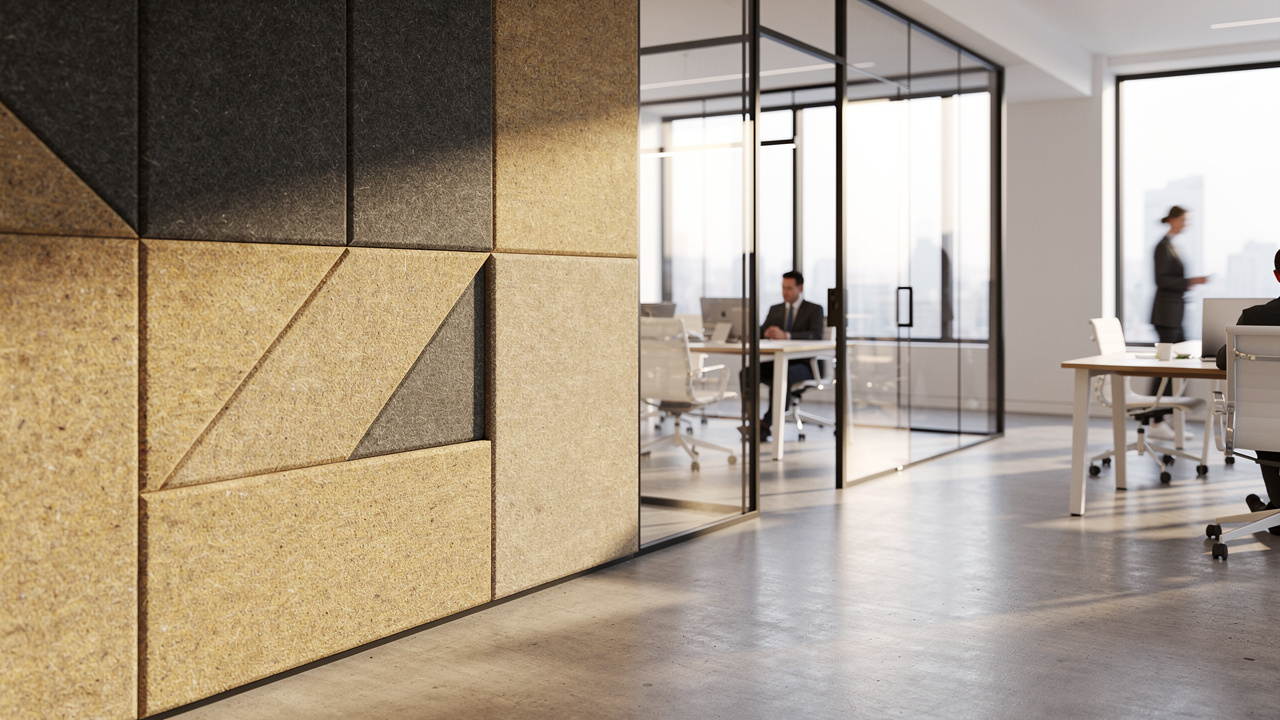
Design flexibility turns PET acoustic panels for Algeria’s office fit-outs into a branding tool rather than a hidden compliance item bolted on after the interior design is finished. Manufacturers now offer color ranges running past 100 shades, letting designers match panels precisely to corporate palettes instead of settling for a generic neutral tone. Custom UV printing takes this further, allowing logos, patterns, or full graphic artwork to be printed directly onto the panel surface so acoustic treatment and brand identity share the same wall.
CNC cutting adds a second layer of design control, since panels can be shaped into curves, perforated patterns, or precise logo cutouts for reception feature walls and ceiling installations. This matters for corporate lobbies where the acoustic wall often doubles as the first visual statement a visitor or client sees. Fit-out teams working across Algiers, Oran, or Constantine can specify one panel system that satisfies acoustic engineers and brand guidelines at the same time.
Sourcing Pet Acoustic Panels For Algerian Fit-Out Projects
Sourcing PET acoustic panels for Algeria’s office fit-outs comes down to verifying documentation and confirming a supplier can deliver consistent quality across a large order, not just a handful of samples. Procurement managers and distributors should treat missing paperwork as a red flag, since fire and acoustic compliance cannot be confirmed after installation without costly testing or removal. Bulk supply reliability matters just as much, because phased Algerian construction schedules leave little room for a supplier that runs out of stock mid-project or ships inconsistent batches between deliveries.
Fire test certificates covering the exact panel thickness and finish being specified should match the specifications listed in the manufacturer’s own technical datasheet rather than a general distributor catalog.
NRC and sound absorption reports from an accredited testing lab, since published averages can differ from actual site performance depending on mounting.
Recycled content documentation, useful for projects pursuing LEED, BREEAM, or similar green building credits tied to material sourcing.
Confirmed lead times and minimum order quantities that account for shipping and customs clearance into Algeria before construction milestones.
Why DeSound Fits Algerian Office Fit-Out Needs

DeSound addresses the sourcing risks above directly through ready-stock availability, which shortens delivery timelines for contractors working against tight Algerian project schedules instead of waiting on custom production runs. Precision CNC cutting and custom UV printing let design teams get tailored office layouts and branded feature walls without switching suppliers for the acoustic component and the design component separately.
Its panels carry Class A fire ratings and high-NRC acoustic performance, backed by documented test data that procurement teams can submit alongside building compliance paperwork. With over 100 color options and bulk supply capability built for large-scale projects, DeSound gives architects, contractors, and distributors one source for both compliance and design flexibility across an entire office fit-out.
Tip for procurement teams: treat every acoustic panel quote as incomplete until it comes with a fire test certificate and an accredited NRC report attached, not just a product brochure.
The Takeaway
Acoustic treatment has stopped being optional for modern Algerian office fit-outs, since open floor plans and hard, climate-driven finishes create noise problems that hurt concentration and privacy the moment a building opens. PET acoustic panels solve this without forcing a trade-off between performance and design, offering documented fire safety, strong NRC ratings, and color or printing options that let acoustic treatment double as a branding feature.

Before placing an order, verify every technical document a supplier offers, from fire certificates to NRC test reports, and confirm bulk lead times fit your construction schedule. DeSound supplies ready-stock, Class A fire-rated PET acoustic panels with CNC cutting and custom UV printing built for exactly this kind of Algerian office project, making it worth a call before finalizing your specification.
Frequently Asked Questions
Are Pet Acoustic Panels Suitable For Algeria’s Humid Coastal Climate?
Yes, PET felt resists moisture, mold, and mildew because the synthetic fiber structure gives fungi nothing to feed on. This holds true across Algeria’s varied climate zones, from humid coastal cities like Algiers and Oran to drier interior regions, without the panel losing shape or acoustic performance over time.
Do Pet Acoustic Panels Contain Harmful Chemicals Or Vocs?
No, quality PET acoustic panels are made without formaldehyde or added resins, so they don’t emit volatile organic compounds after installation. This matters for occupied office environments, where indoor air quality affects staff comfort and supports green building certification goals like LEED or BREEAM.
How Many Recycled Bottles Go Into A Single Pet Acoustic Panel?
A standard-sized PET acoustic panel typically uses the fiber equivalent of 40 to 60 recycled plastic bottles. This makes the material a genuine contributor to circular economy goals rather than a marketing claim, which matters for Algerian projects pursuing sustainability credits.
Can Pet Acoustic Panels Be Installed On Existing Office Walls Without Major Renovation?
Yes, panels can be mounted using construction adhesive or mechanical fixings like screws and clips, depending on the substrate and whether future reconfiguration is likely. They work well on concrete, gypsum board, and metal stud framing, all common in Algerian office construction.
What Is The Typical Lead Time For Bulk Pet Panel Orders In Algeria?
Ready-stock inventory can cut delivery times significantly compared with fully custom production runs, which often take several weeks to manufacture. Procurement teams should still factor in shipping and customs clearance into Algeria when setting project milestones, since import logistics add time beyond the supplier’s own dispatch date.
How Do Pet Panels Compare To Mineral Wool For Office Acoustics?
PET panels resist moisture better and don’t shed irritant fibers during cutting or installation, unlike mineral wool, which often needs protective equipment for installers. Both materials absorb sound effectively, but PET panels offer safer handling and a more consistent finish for occupied office spaces.