
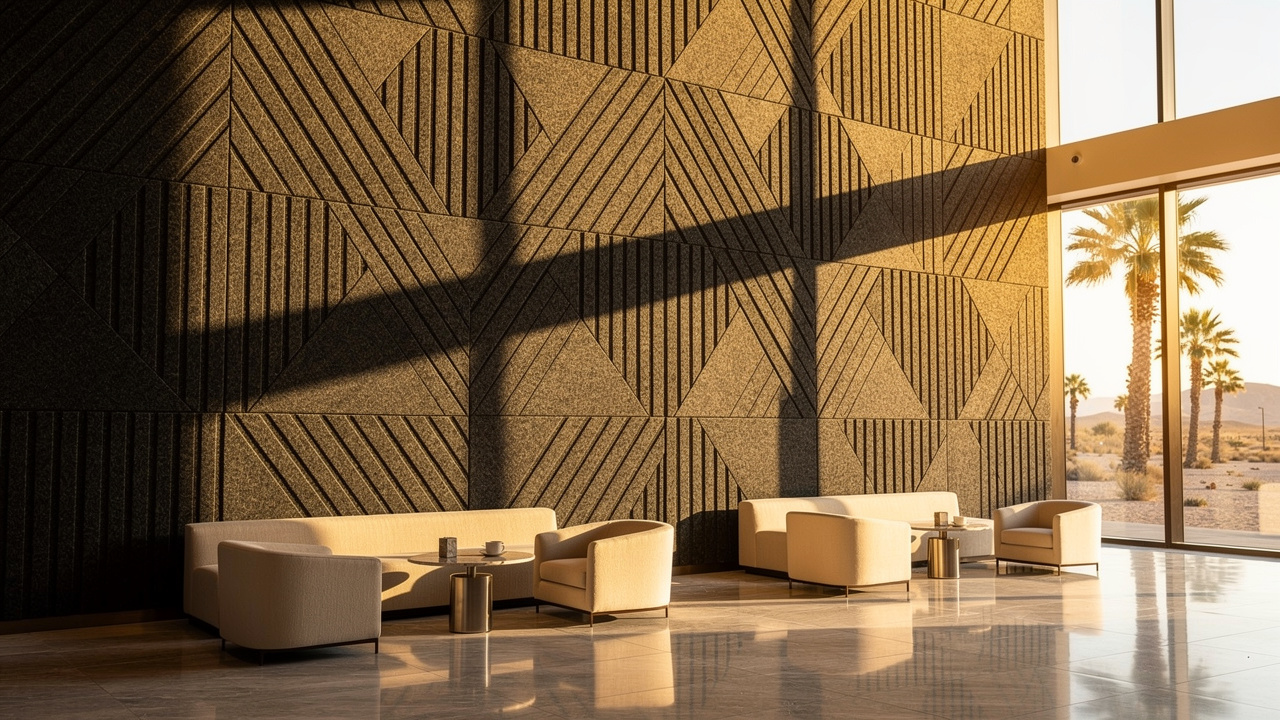
Hotels and office towers across Egypt keep getting louder, and the usual fixes rarely match the design vision architects have in mind. Open lobbies, glass-heavy ballrooms, and hard-surfaced conference rooms bounce sound around instead of absorbing it, leaving guests and staff dealing with noise nobody planned for. PET acoustic panels for Egypt’s hospitality and commercial sector solve this by combining sound absorption with a finish that actually looks intentional. These panels are made from recycled polyester felt, and they now show up in hotel lobbies from the Red Sea to the New Administrative Capital, in office fit-outs across New Cairo, and in schools that need clearer classrooms. This article walks through what these panels are made of, which product types fit specific hospitality and commercial applications, what performance and fire data to check before you specify them, and how to source them reliably in bulk. DeSound, a supplier of PET acoustic panels serving Egypt’s commercial and hospitality building sector, appears throughout as one example of how these sourcing questions get answered in practice.
Key Takeaways
PET acoustic panels are made from at least 60% recycled plastic bottles and typically reach NRC ratings between 0.65 and 0.95, depending on thickness and mounting.
Their moisture resistance and light weight make them well suited to Egypt’s coastal humidity and to renovation projects in older Cairo buildings.
DeSound offers ready-stock panels, CNC cutting, and custom UV printing, which cuts lead-time risk on large hotel and commercial orders.
Class A fire rating and documented acoustic test data are non-negotiable checks before any bulk order gets approved.
Bulk buyers should weigh batch consistency, lead time, and sustainability documentation when picking a supply partner.
What Are Pet Acoustic Panels and How Do They Work?

PET acoustic panels are sound-absorbing boards made from polyester fiber, most of it recycled from post-consumer plastic bottles, pressed into a dense felt that soaks up sound instead of reflecting it. The process starts with shredded PET plastic sourced from the growing supply of recycled bottles, since the 2023 US PET bottle recycling rate reached its highest level in decades, which then gets melted and spun into fine polyester fibers, then thermally bonded under heat and pressure into a rigid or semi-rigid sheet, all without added resins or glues. Reputable panels carry a minimum of 60% recycled content, a figure consistent with the North American PET recycling rate surpassing 40 percent reported industry-wide, and the base layer is usually a dense black felt that does the acoustic work, while a second facing layer, whether painted, fabric-wrapped, or veneered, handles the look. This two-layer build is what lets one product line serve both a plain office wall and a five-star hotel lobby. Compared with mineral wool or fiberglass, PET panels release no irritating fibers during cutting or installation, need no extra encapsulation, and carry none of the formaldehyde or added chemical binders found in some older acoustic products, which matters in occupied spaces like guest rooms, classrooms, and open-plan offices where air quality is part of the specification.
Why Pet Panels Suit Egypt’s Climate and Construction Needs

PET acoustic panels handle Egypt’s mix of coastal humidity and dry inland heat better than most traditional acoustic materials, largely because the felt core resists moisture absorption and does not support mold growth the way wood fiber or mineral wool can. That resistance matters directly for hospitality developments along the Red Sea, the North Coast, and Alexandria, where air-conditioned interiors sit next to humid exteriors for most of the year, and where a material that warps or discolors within a season becomes an expensive callback. The panels also weigh far less than mineral fiber or dense wood-based boards, which lowers shipping costs and reduces the structural load placed on ceilings and partition walls. That weight advantage counts for a lot in renovation projects inside Cairo’s older commercial buildings, where existing structures were not built with heavy new finishes in mind, and where faster, lighter installation keeps fit-out schedules on track.
Which Pet Acoustic Panel Types Fit Hotel and Commercial Projects?

Hotel and commercial developments rarely need just one acoustic product, since a lobby, a ballroom, and a back-office floor all call for different finishes and mounting details even when the underlying acoustic goal is the same. The core PET felt material stays consistent across product lines, but manufacturers vary the facing, the cut pattern, and the panel profile to match each application, which is why architects can specify one acoustic system and still get a coherent design language across a whole property. CNC cutting technology plays a big part in this flexibility, letting suppliers produce precise groove patterns, custom sheet sizes, and repeatable geometry across large orders. Custom UV printing and wide color ranges add another layer of design control, letting acoustic panels double as branded surfaces rather than sitting apart from the interior scheme. The following product types cover most of what architects and fit-out contractors specify on Egyptian hospitality and commercial projects today.
Pet Acoustic Felt Wall Panels
These are flat, felt-textured panels available in a wide spread of colors, and they work as both noise control and a design accent in one product. Open-plan offices and lobbies use them to cut reverberation and improve speech privacy between workstations, while the color range lets designers tie the panels into a brand palette instead of settling for a plain gray board.
Acoustic Grooved Wood Slat Wall Panels
This hybrid product pairs a dense black PET felt core with a facing layer of reconstituted wood veneer, available in several species and finishes. It suits lobbies, reception desks, and boardrooms where a warm, natural look matters as much as the acoustic performance hidden behind the surface.
Acoustic V-Groove Wall Panels
Made using CNC machining, these panels carry precise 45-degree or 90-degree grooves cut into the felt surface, and sheet sizes can be customized to match a specific wall run. Conference centers and hotel lobbies favor this option when a clean, linear architectural pattern is part of the design brief.
3D Acoustic Wall Panels
Molded or cut into geometric, dimensional patterns, these panels add visual depth to a wall while still delivering the sound absorption of standard PET felt. Hospitality lobbies and retail interiors use them most often as accent walls where the acoustic panel is meant to be noticed, not hidden.
Acoustic Ceiling Panels
Built to drop into standard suspended ceiling grids, these panels come sized for 12mm, 24mm, and 30mm exposed tee systems, which means contractors can install them into existing grid infrastructure without reworking the ceiling. That compatibility matters most in renovation and fit-out projects where replacing the whole grid isn’t part of the budget.
Acoustic Wooden Slat Panels
Combining decorative wood slats with an acoustic felt backing, these panels give walls and ceilings a textured, natural appearance while still cutting reverberation. Modern hotel corridors and commercial reception areas use them when a premium, tactile finish is part of the brief.
What Acoustic Performance and Fire Safety Standards Should You Verify?

Acoustic performance on PET panels is measured by the Noise Reduction Coefficient, or NRC, a number between 0 and 1 that shows how much sound a material absorbs rather than reflects. Well-made PET panels typically land between 0.65 and 0.95 NRC, a range that holds up against premium mineral fiber and foam products, and recent research on waste-based bioplastic wall panels for acoustic performance confirms that thickness, density, and mounting method are the main variables driving that figure. Panels installed with an air gap behind them, rather than flush against a solid wall, absorb noticeably more low-frequency sound, a finding echoed in acoustic performance optimization research on fiber-based composite panels, which matters in ballrooms and restaurants where bass-heavy music and crowd noise are the main problem. Fire safety is the other non-negotiable check, and any panel specified for a hotel, office tower, or school in Egypt should carry documented Class A fire-rated performance along with acoustic test data referenced to recognized standards such as ASTM C423 or ISO 354.
Procurement managers and architects should ask suppliers for fire and acoustic documentation upfront rather than after an order ships, since missing fire certificates can hold up occupancy approval on a finished building.
| Material | Sound Absorption | Weight | Moisture Resistance |
|---|---|---|---|
| PET Acoustic Panels | High, NRC 0.65-0.95 | Lightweight | Excellent |
| Mineral Wool | High | Heavy | Moderate |
| Fiberglass Panels | High | Moderate | Poor, irritant fibers |
How DeSound Supports Specification and Bulk Procurement
DeSound addresses the sourcing risk built into large hotel and commercial orders by keeping PET acoustic panels in ready stock, which cuts the lead-time delays that come with fully custom manufacturing on every order. Its panels carry Class A fire rating and high-NRC acoustic performance, backed by manufacturing quality that stays consistent across the volume a multi-floor hotel or office fit-out typically needs. For projects that need a brand-matched look rather than an off-the-shelf finish, the supplier offers custom UV printing, CNC cutting for precise groove and geometric patterns, and over 100 color options, giving architects and interior designers a way to align acoustic treatment with an established design scheme. Fit-out contractors and project managers working through specification questions also get direct technical support, which helps confirm the right thickness and mounting method before installation begins rather than after a wall goes up wrong.
How Should You Source Pet Acoustic Panels for Large-Scale Egyptian Projects?

Sourcing PET acoustic panels for Egypt at scale comes down to a short list of checks that separate a reliable supply partner from one that causes delays halfway through a project. Buyers should look at:
Batch-to-batch consistency in color and density, since a hotel corridor with visibly mismatched panels becomes a costly fix after installation.
Lead time reliability, particularly for phased projects where panels arrive in stages tied to a construction schedule.
Documentation of recycled content, fire rating, and acoustic test data should also account for year-over-year shifts, since a recent industry report on North American PET industry resiliency showed recycling rates can fluctuate even as they remain above historical averages, so buyers should confirm current sourcing figures before an order is placed rather than after.
Sustainability credentials, since PET panels built from recycled plastic bottles can support green building certification credits on projects pursuing LEED, BREEAM, or Egypt’s own Green Pyramid Rating System.
Buyers who treat these checks as standard due diligence, rather than an afterthought, avoid most of the supply headaches that show up on large hospitality and commercial builds.
The Takeaway
PET acoustic panels for Egypt’s hotel and commercial sector solve a real design problem, letting architects control noise without giving up the finish quality a five-star lobby or a branded office floor demands. Their recycled composition, strong NRC performance, and resistance to humidity and mold make them a practical fit for coastal resorts, Cairo office towers, and school buildings alike, while CNC cutting and custom color options keep the aesthetic side just as flexible. Getting the sourcing right still matters more than the product choice itself, since fire documentation, batch consistency, and lead time determine whether a project stays on schedule. Suppliers such as DeSound, with ready stock and Class A fire-rated panels on hand, give architects, contractors, and procurement teams a starting point for evaluating what a bulk order should look like before committing to one.
Frequently Asked Questions
Are Pet Acoustic Panels More Expensive Than Traditional Mineral Wool Panels?
Upfront pricing sits in a similar range to mineral wool in most cases, but PET panels tend to deliver better long-term value. They resist moisture and don’t degrade the way mineral wool can in humid conditions, and their lighter weight cuts installation labor, which offsets any small difference in material cost over a project’s life.
Can Pet Acoustic Panels Be Installed Over Existing Wall Finishes Without Major Renovation?
Yes, adhesive mounting and clip systems both work well over existing finishes, making PET panels a practical retrofit option. Clip systems also allow for demountable installation, which helps when a hotel or office space might need access behind the panel later for maintenance or reconfiguration.
How Long Does It Typically Take to Receive Bulk Orders of Pet Acoustic Panels in Egypt?
Lead time depends heavily on whether panels are custom-manufactured or held in ready stock. Fully custom orders with specific sizing or veneer finishes take longer to produce, while ready-stock inventory, like the kind the platform maintains, can ship far faster, which matters most on projects with a fixed opening date.
Do Pet Acoustic Panels Require Special Maintenance in High-Traffic Hospitality Environments?
No special maintenance is needed beyond routine cleaning with a soft brush or vacuum attachment. The felt surface holds up well against daily wear, and its resistance to moisture and mold means humid hotel corridors and bathrooms near acoustic walls don’t shorten the panel’s usable life.
What Thickness of Pet Acoustic Panel Is Best for Hotel Ballrooms Versus Guest Corridors?
Ballrooms generally benefit from thicker panels, often 24mm to 30mm or more, mounted with an air gap to absorb the low-frequency noise from music and crowds. Guest corridors, which deal mostly with footsteps and conversation, usually perform well with thinner panels, often direct-mounted, since the reverberation problem is smaller in scale.
Can Pet Panels Be Customized to Match a Hotel Brand’s Specific Color Palette?
Yes, PET acoustic panels are available in a wide color range, and suppliers offering custom UV printing can match specific brand colors or patterns directly onto the panel surface. This lets hospitality brands keep visual consistency across lobbies, corridors, and meeting spaces.
Do Pet Acoustic Panels Contribute to Green Building Certifications in Egypt?
Yes, because PET panels are made from a high percentage of recycled plastic bottles, they can support recycled-content and low-emitting material credits under certification systems like LEED or Egypt’s Green Pyramid Rating System, giving developers a documented sustainability advantage on the project.