
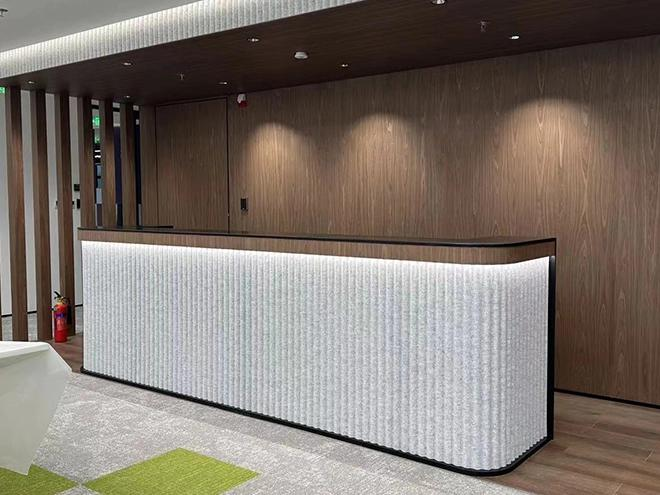
Modern commercial and public buildings in Zambia are increasingly designed around comfort, functionality, sustainability, and user experience. From corporate offices and banks to government facilities, schools, conference centers, healthcare facilities, and public halls, controlling indoor noise is an important part of creating effective spaces.
This is particularly relevant in modern office developments in Lusaka. For example, Zambia has seen commercial projects incorporating dedicated acoustic treatment, including open-plan offices and meeting rooms. Standard Chartered House in Lusaka was designed with acoustic treatment to absorb sound, reduce noise, and enhance privacy.
PET acoustic panels provide a flexible solution for these environments, combining sound absorption with contemporary interior design.
What Are PET Acoustic Panels?
PET acoustic panels are sound-absorbing products manufactured from polyester fiber, commonly incorporating recycled PET material. Their fibrous structure helps absorb reflected sound and reduce reverberation within interior spaces.
They can be installed on:
- Walls
- Ceilings
- Open-plan office partitions
- Meeting-room walls
- Corridors
- Reception areas
- Conference rooms
- Auditoriums
- Educational facilities
- Public waiting areas
PET panels are available in different thicknesses, colors, shapes, and configurations, allowing architects and interior designers to combine acoustic performance with decorative design.
Why Acoustic Treatment Matters in Zambian Buildings
Commercial and public buildings often contain large numbers of people, hard surfaces, glass, concrete, furniture, and mechanical equipment. Without sufficient sound absorption, these surfaces can reflect sound and create excessive reverberation.
This can make it harder to:
- Understand conversations
- Conduct meetings
- Hear presentations
- Communicate at reception desks
- Concentrate in offices
- Use conference facilities comfortably
- Deliver clear announcements in public spaces
Zambia’s commercial construction sector includes office buildings, institutional facilities, shopping centers, and other developments where acoustic comfort can form an important part of interior planning.
Benefits of PET Acoustic Panels for Commercial Buildings
1. Improved Speech Clarity
Clear communication is essential in offices, conference rooms, banks, customer-service areas, and meeting spaces.
PET acoustic panels absorb reflected sound, helping reduce excessive reverberation and creating a more comfortable environment for conversations.

2. Better Open-Plan Office Acoustics
Open-plan offices can encourage collaboration but may also allow conversations and telephone calls to spread across the workspace.
A combination of PET wall panels, ceiling baffles, and acoustic screens can help control reflected sound while maintaining an open workplace layout.
3. Attractive Interior Design
Acoustic products do not need to look purely functional. PET panels can become architectural design features.
They can be manufactured or arranged as:
- Geometric patterns
- Vertical fins
- Decorative wall designs
- Curved panels
- Suspended baffles
- Ceiling rafts
- Acoustic screens
- Branded installations
This makes PET panels particularly suitable for contemporary commercial interiors.
4. Lightweight Acoustic Solution
PET panels are relatively lightweight and can be integrated into new construction as well as refurbishment projects.
They can be installed without substantially changing the overall architectural character of an existing space, making them useful for office renovations and public-building upgrades.
PET Acoustic Panels for Public Buildings in Zambia
Public buildings often have different acoustic requirements from private offices because they may accommodate large numbers of visitors simultaneously.
Government Buildings
Government offices may include reception areas, public service counters, meeting rooms, conference facilities, and administrative offices.
PET wall panels and ceiling baffles can help improve acoustic comfort in these busy environments.
Zambia currently has government-building projects listed across different regions, including office facilities and other public infrastructure.

Schools and Universities
Classrooms, lecture rooms, libraries, and university facilities can benefit from improved speech intelligibility.
Teachers and lecturers need their voices to reach students clearly without excessive echo.
PET acoustic wall panels can be positioned on selected reflective surfaces, while ceiling baffles or acoustic rafts can provide additional absorption.
Hospitals and Healthcare Facilities
Healthcare environments require comfortable communication between staff, patients, and visitors.
Acoustic panels can be considered for:
- Waiting areas
- Consultation rooms
- Reception spaces
- Corridors
- Staff offices
- Meeting rooms
For healthcare projects, product selection should also consider the required hygiene, cleaning, fire, and infection-control specifications.
Libraries
Libraries need a balance between quietness and comfortable occupancy.
PET acoustic panels can help control reverberation from footsteps, conversations, furniture movement, and other interior activity.
Conference and Convention Centers
Large conference spaces can have significant acoustic challenges because of their size and hard architectural surfaces.
PET ceiling baffles and wall panels can be arranged strategically to help control reflected sound and support clearer presentations and discussions.
PET Acoustic Ceiling Baffles for Large Spaces
Ceiling baffles are particularly useful where wall space is limited or where designers want to preserve an open architectural appearance.
Suspended PET baffles can be arranged in:
- Straight rows
- Parallel lines
- Wave patterns
- Vertical configurations
- Geometric formations
- Custom architectural layouts
They can also be coordinated with lighting, HVAC systems, and other ceiling services.
PET Acoustic Panels for Lusaka’s Modern Commercial Spaces
Lusaka has an expanding portfolio of office and commercial developments. Existing projects include modern office parks, multistory office buildings, and institutional facilities.
The COMESA headquarters development in Lusaka also demonstrates the scale and variety of spaces that can exist within a contemporary institutional building, including public areas, conference facilities, staff offices, executive offices, and service spaces.
Each of these spaces can have different acoustic requirements.
For example:
| Building Area | Suitable PET Acoustic Solution |
|---|---|
| Open-plan office | Wall panels + ceiling baffles |
| Meeting room | Wall panels + ceiling treatment |
| Reception | Decorative wall panels |
| Conference room | Wall panels + ceiling rafts |
| Corridor | Decorative ceiling panels |
| Classroom | Wall panels + ceiling absorption |
| Library | Wall panels + acoustic ceiling elements |
| Public waiting area | Ceiling baffles + wall panels |
| Auditorium | High-coverage wall and ceiling treatment |
Sustainable Acoustic Design
Sustainability is becoming increasingly relevant to commercial building design in Zambia. Some local developments have incorporated environmental certification and strategies addressing indoor environmental quality.
For example, Zambia’s Standard Chartered House has been reported as an EDGE-certified office building, with low-VOC materials used as part of its indoor environmental-quality approach.
PET acoustic panels containing recycled polyester can complement sustainability-focused interiors. However, project teams should always request actual product documentation for recycled content, VOC performance, fire classification, acoustic testing, and applicable environmental certifications rather than assuming that every PET panel has the same specifications.

Decorative PET Acoustic Wall Panels
One of the biggest advantages of PET panels is their design flexibility.
Instead of covering an entire wall with a conventional acoustic treatment, designers can create a feature wall using different colors, shapes, or panel orientations.
For corporate buildings, panels can even be coordinated with company branding.
Important Factors When Selecting PET Acoustic Panels
Before specifying PET acoustic panels for a Zambian commercial or public-building project, architects, contractors, and procurement teams should evaluate:
Acoustic Performance
Check independently tested sound-absorption data and select a solution appropriate for the room’s size and intended use.
Panel Thickness
Thickness influences acoustic performance, particularly at different frequency ranges. The appropriate thickness should be selected based on the acoustic requirements of the space.
Fire Performance
Commercial and public projects should use products with suitable fire-test documentation and classifications required by the project.
Recycled Content
If sustainability is a project priority, request documentation confirming the percentage and source of recycled PET content.
VOC and Indoor Air Quality
For offices, schools, healthcare facilities, and other occupied buildings, review available VOC and indoor-air-quality documentation.
Installation Method
Consider whether the project requires:
- Wall-mounted panels
- Suspended baffles
- Ceiling rafts
- Acoustic screens
- Freestanding partitions
- Decorative feature panels
Maintenance
Select surfaces and colors appropriate for the building’s expected traffic, cleaning procedures, and maintenance requirements.
PET Panels vs. Soundproofing
It is important to understand that acoustic absorption and soundproofing are not the same thing.
PET acoustic panels primarily help control sound inside a room by absorbing reflected sound and reducing reverberation.
They do not by themselves provide complete sound insulation between rooms.
If a project requires speech privacy or isolation between spaces, the acoustic design may also need:
- Acoustic partitions
- Insulated walls
- Acoustic doors
- Door seals
- Acoustic glazing
- Floor/ceiling assemblies
- Other sound-isolation measures
A complete acoustic strategy should therefore consider both room acoustics and sound transmission.

Why Choose Desound PET Panels for Zambian Projects?
For commercial and public-building projects, Desound PET Panels can provide versatile acoustic solutions for architects, interior designers, contractors, and facility managers.
Potential applications include:
- PET acoustic wall panels
- PET felt panels
- Acoustic ceiling baffles
- Decorative acoustic panels
- Acoustic screens
- Office acoustic solutions
- Conference-room treatments
- Educational acoustic treatments
- Public-building acoustic solutions
- Custom acoustic designs
The correct configuration can be developed according to room dimensions, ceiling height, existing finishes, occupancy, furniture, and acoustic objectives.
Conclusion
PET acoustic panels offer a practical combination of sound absorption, design flexibility, and sustainability for commercial and public buildings in Zambia.
From corporate offices and banks in Lusaka to government buildings, schools, conference facilities, libraries, healthcare environments, and public spaces, PET acoustic products can help create more comfortable and functional interiors.
With the right combination of PET wall panels, ceiling baffles, acoustic screens, and other sound-control measures, Zambian building projects can achieve better acoustic comfort without compromising contemporary interior design.
Desound PET Panels can help architects and project teams create acoustic environments that are functional, attractive, and suitable for the demands of modern commercial and public buildings in Zambia.