
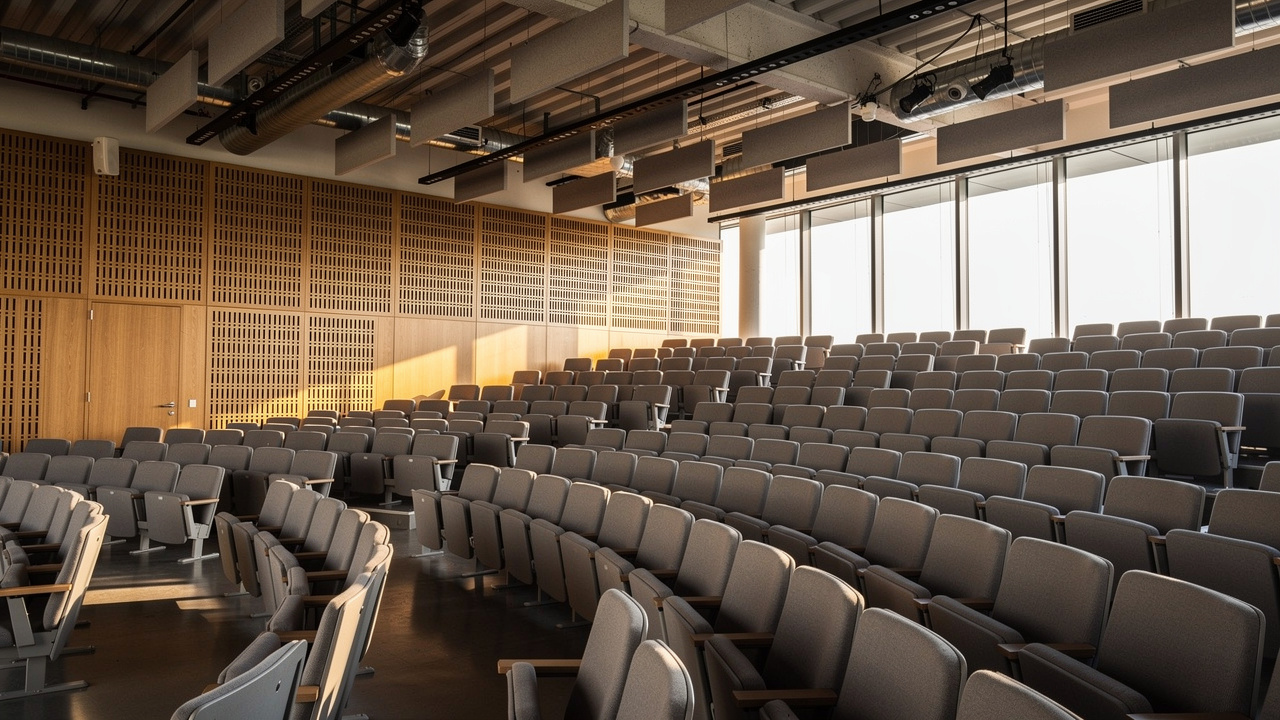
Lecture halls with exposed concrete, glass-walled research labs, and centuries-old buildings repurposed for modern classrooms all share one acoustic problem across Massachusetts higher education campuses. Sound bounces off hard surfaces, reverberation times climb, and students in the back row strain to catch every word over the hum of HVAC systems. Facilities teams in Boston, Cambridge, and Worcester face this challenge constantly as historic masonry and plaster interiors get converted into active teaching and research space, and high occupant density in open labs and library commons only makes speech clarity harder to achieve.
PET acoustic panels for Massachusetts universities and research centers address this problem directly, without demanding costly structural changes to a building’s shell. Made from recycled polyester fiber, these panels deliver a Noise Reduction Coefficient between 0.70 and 0.95, meet Class A fire ratings, and come in colors and shapes that match campus branding. DeSound, a manufacturer of PET acoustic panel systems, supplies this exact combination of performance, compliance, and design flexibility to institutional projects. This article covers why campus buildings need targeted acoustic treatment, how panel performance varies room to room, how large-scale procurement works, sustainability advantages, and what to check before specifying.
Key Takeaways
PET acoustic panels meet the Class A fire ratings that Massachusetts educational occupancies typically require for interior finishes.
NRC ratings between 0.70 and 0.95 make these panels suitable for lecture halls, research labs, and open study areas alike.
Design flexibility, including custom colors and UV-printed branding, lets campuses reinforce their visual identity while treating noise.
Ready-stock inventory and bulk supply capacity keep phased, multi-building campus renovations moving without long fabrication delays.
Recycled PET content and low-VOC properties support LEED and sustainability commitments common across Massachusetts research institutions.
Why Do Massachusetts Campuses Need Specialized Acoustic Treatment?

Massachusetts campuses need specialized acoustic treatment because hard finishes, open-plan labs, and historic buildings adapted for modern teaching all amplify reverberation past comfortable listening levels. Exposed concrete ceilings, glass partition walls, and century-old masonry in adaptive-reuse buildings across Boston, Cambridge, and Worcester reflect sound instead of absorbing it, while open-plan research labs add equipment noise and cross-talk between workstations on top of that problem.
Most institutions target an NRC between 0.70 and 0.95 for primary sound-absorbing surfaces, paired with low-VOC materials that support indoor air quality. Panels also need to satisfy fire rules under the International Building Code as adopted by the Massachusetts State Building Code, plus alignment with WELL and LEED standards that campus sustainability offices increasingly require before approving a material.
What Makes PET Acoustic Panels Ideal for Academic Facilities?

Recent research on natural-fiber micro-perforated panel acoustic performance optimization confirms that PET acoustic panels for Massachusetts academic facilities work because of a simple process happening inside the material itself. Each panel is built from tightly packed polyester fibers with countless tiny air pockets, and when sound waves travel into that structure, friction between the moving air and the fibers converts sound energy into a small amount of heat, which lowers reverberation and sharpens speech clarity.
Thickness and mounting method both change how much sound gets absorbed:
A one-inch panel typically reaches an NRC near 0.70, fine for general classroom use.
A two-inch panel can reach an NRC close to 0.95, better suited to lecture halls, gyms, and other large-volume spaces where reverberation time is harder to control.
Adding an air gap behind a panel, even a small two to four inch cavity, boosts low and mid-frequency absorption noticeably, which matters in seminar rooms where a professor’s voice needs to carry clearly to the back row.
Different campus spaces call for different formats built on that same material platform. Lecture halls benefit from flat wall panels at first-reflection points combined with an absorptive ceiling. Research labs need impact-resistant, moisture-tolerant panels that hold up against daily equipment use and occasional spills. Libraries and learning commons often use suspended baffles or clouds that manage noise across open floor plans without blocking sightlines between study areas.
How Do PET Panels Perform Across Different Campus Spaces?

Lecture halls and seminar rooms benefit most from wall panels placed at first-reflection points paired with absorptive ceiling tiles, a combination that raises speech intelligibility without changing sightlines to the podium. Research labs call for impact-resistant, moisture-tolerant wall panels that withstand daily contact near equipment and chemical-adjacent workstations, a use case echoed in multifunctional performance assessment research on bioplastic wall panels evaluating acoustic, thermal, and structural durability in interior settings, where a fabric-faced panel would wear out fast.
Libraries and learning commons rely on ceiling baffles or clouds suspended above open study zones, controlling noise buildup while keeping the room feeling open and connected. Gyms, cafeterias, and assembly halls need large-format baffles and clouds sized to match their high-volume, high-occupancy noise loads, where a small wall panel alone would barely register against the room’s total surface area.
How Does DeSound Support Large-Scale University Procurement?

DeSound supports large-scale university procurement by combining ready-stock inventory with the fabrication flexibility that multi-building campus projects actually need. Massachusetts campus renovations rarely happen all at once, they move building by building across academic years, grant cycles, and construction windows tied to summer breaks, which means a supplier has to keep consistent stock on hand rather than treating every order as a custom production run from scratch.
A facilities team starting a science building retrofit this fall should not have to wait months to begin work on the library next spring.
The company holds core panel thicknesses and colorways in ready stock, supporting exactly that kind of staggered timeline. Precision CNC cutting lets each building receive panels shaped for its specific ceiling grid, wall geometry, or baffle layout, without sacrificing the visual consistency a campus master plan usually demands across departments. For institutions that want an acoustic upgrade to reinforce campus identity, custom UV printing applies university logos, wayfinding graphics, or department colors directly onto the panel surface, and a palette of more than 100 standard colors covers most brand guideline requirements without a custom dye run.
Every panel also carries a Class A fire rating, which matters heavily in educational occupancies where code officials review submittals closely before construction proceeds. Perhaps most important for procurement managers juggling several purchase orders across a multi-year renovation plan, manufacturing quality stays consistent from batch to batch, so a panel ordered for a chemistry building in year one matches the panel ordered for the adjacent engineering building in year three.
What Procurement Challenges Do Universities Face, and How Does DeSound Solve Them?
University procurement teams juggle several recurring challenges when sourcing PET acoustic panels for Massachusetts campus programs, from mismatched inventory to compliance paperwork that can stall a project at the permitting stage. Facilities directors also have to balance acoustic performance against branding standards, since a purely functional panel choice can clash with a university’s visual identity guidelines.
The table below maps the most common procurement pain points to how DeSound’s panel program responds to each one.
| Challenge | DeSound’s Response |
|---|---|
| Diverse acoustic needs across facility types | High-NRC panel range with CNC customization for each space |
| Fire and safety code compliance | Class A fire-rated panels documented for AHJ submittal |
| Budget and grant-funded timeline pressure | Ready-stock inventory and bulk supply minimize delays |
| Multi-phase consistency across buildings | Manufacturing uniformity prevents mismatched panels between installs |
| Balancing acoustics with campus branding | Custom UV printing and over 100 color options |
How Do PET Panels Support Sustainability Goals on MA Campuses?
PET acoustic panels for Massachusetts campuses support sustainability goals because they are made largely from post-consumer recycled plastic bottles rather than virgin material. That recycled content can contribute toward LEED Materials and Resources credits, which matters for research institutions and universities that have committed to formal sustainability certifications across their building portfolios, and diverting plastic waste into a functional material gives sustainability offices an easy story to tell on campus tours.
Beyond recycled content, PET panels are hypoallergenic, odor-free, and typically manufactured with low-VOC emissions, properties that matter directly in laboratories, classrooms, and shared study spaces where indoor air quality affects occupant comfort. These traits support broader indoor environmental quality goals tied to WELL and LEED, giving facilities teams one material that checks both acoustic and sustainability boxes at once.
What Should Architects and Contractors Know Before Specifying?

Architects and contractors should verify three things on any product data sheet before finalizing a specification for PET acoustic panels in Massachusetts, the tested NRC rating, fire performance documentation, and recycled content certification. NRC values should come from independent acoustic testing rather than manufacturer estimates alone, and fire ratings need to match the exact occupancy classification a local building official will review during permitting.
Mounting method deserves equal attention, especially on occupied, phased renovations where classes continue while construction happens nearby:
Direct adhesive works for straightforward wall coverage.
Mechanical clips, commonly used with recycled polyester fiber acoustic panels such as PET felt panel systems, allow future access to services behind a panel.
T-bar grid integration suits existing suspended ceilings in office-style buildings.
Suspension systems handle baffles and clouds in gyms or dining halls.
Matching the mounting method to a building’s real construction sequence avoids costly rework later.
The Takeaway
Choosing PET acoustic panels for Massachusetts university and research center projects solves three problems at once, poor speech clarity, fire and sustainability compliance, and the need to keep campus branding intact. A single panel family can move from a lecture hall to a research lab to a library commons while meeting the same NRC targets, the same fire ratings, and the same visual language across an entire campus.
Facilities directors and design teams working through a phased renovation should request product data sheets, sample panels, and a bulk quote early in planning. DeSound offers specification support, sample requests, and bulk pricing for institutions ready to move forward with a coordinated acoustic upgrade.
Frequently Asked Questions
What NRC Rating Is Recommended For University Lecture Halls?
Most lecture halls perform well with an NRC between 0.70 and 0.95, depending on ceiling height and room volume. Larger, higher-volume rooms generally need panels toward the higher end of that range, and speech intelligibility targets often align with ANSI S12.60 classroom acoustic standards.
Are PET Acoustic Panels Durable Enough For High-Traffic Research Labs?
Yes, PET panels resist impact and moisture well, making them suitable for lab corridors and equipment areas that see daily contact and occasional spills. Industrial-grade variants also tolerate bleach cleaning, which helps in spaces that require regular disinfecting protocols.
Can PET Panels Be Customized With University Logos Or Brand Colors?
Yes, custom UV printing applies logos, wayfinding graphics, or brand colors directly onto the panel surface. Combined with over 100 standard color options, this makes it easy to match department branding, wayfinding systems, or official campus color standards without a separate finishing step.
How Long Does It Take To Source PET Panels For A Multi-Building Campus Renovation?
Ready-stock availability allows prompt fulfillment for core thicknesses and colorways, often faster than fully custom production runs. Bulk supply capacity also supports phased, multi-building rollouts, so later phases can match earlier ones without long waits between orders.
Do PET Acoustic Panels Meet Massachusetts Fire Code Requirements?
Class A fire-rated PET panels are widely available and documented for AHJ submittal during permitting. Architects and contractors should still confirm the specific fire test documentation against the Massachusetts State Building Code for their exact occupancy classification before finalizing a specification.
Do PET Panels Contribute To LEED Certification For Campus Buildings?
Yes, the post-consumer recycled content in PET panels can contribute toward LEED Materials and Resources credits. Their low-VOC, hypoallergenic properties also support Indoor Environmental Quality credit categories, making them useful across several LEED credit paths at once.